
Gamification After Content Became Free
What happens when consumer apps borrow more from games

I’ve written before about Duolingo, mostly not as a language app but as a game. Probably the most successful game-like utility app in the world.
And to be clear, it’s very good at certain things. It gives you goals. Streaks. Things to chase both short term and long term. You open the app and you know exactly what you’re supposed to do. You see how other people are doing, what league they’re in, whether you’re moving up or down. From a game design point of view, a lot of this is really solid.
But I keep coming back to the same question, which is what value it actually creates.
I honestly don’t think I’ve met anyone who spent a massive amount of time in Duolingo and then could actually speak the language. I had a friend in the VC world who had a daily streak for over a year, learning Finnish. When I tried to talk to him, he basically knew individual words. That was about it. No conversation, no flow.
That feels telling.
You’re probably learning something. You’re likely picking up vocabulary. But you’re not really learning the thing you think you’re learning, and probably not the thing the app implicitly promises. To get conversational, you have to leave the app and do other things.
Which is fine, but then the product is selling progress without outcomes, or at least progress that only really exists inside its own system. An illusion of utility more than the utility itself.
And I think that illusion matters more now than it used to.
Why this suddenly feels relevant
The reason it feels more important now is that the way apps are built has completely changed. With vibe coding and AI, building something usable in a weekend is normal. Shipping it is easy. Generating content is easy.
What’s interesting is that a lot of people building these consumer apps don’t come from game development at all. They don’t have that background or intuition.
Meanwhile, people in mobile games have spent years obsessing over engagement, retention, motivation, progression, and what keeps something interesting after day thirty instead of just day one. They’ve internalized this stuff.
You can feel that difference when you look at consumer apps.
Everything optimizes for the paywall
Most consumer apps still optimize for one thing above everything else, which is converting you to a subscriber as fast as possible. Short onboarding, a bit of novelty, then a paywall.
That’s the loop.
The whole idea of building habits over time, or turning something into a hobby, or giving people a reason to come back beyond obligation just isn’t the priority. Games think about that constantly. Consumer apps mostly don’t.
And that’s why so many of them feel shallow once the initial novelty wears off.
Content is basically free now
This part still surprises me a bit.
In the last six months of building vibe-coded apps myself, I realized just how cheap content has become. You can generate enormous amounts of it. You can create agents that behave like level designers. Things companies used to raise funding for are now just normal parts of the toolbox.
Which makes the shallowness of a lot of apps feel even stranger.
If content is cheap, there’s no real excuse not to build depth.
Some categories already hint at this
There are a few categories where you can already see hints of what’s coming.
Couples apps are interesting here, partly because I’m building one myself. “The Truth or Dare” category in particular has exploded. A lot of these apps are making real money.
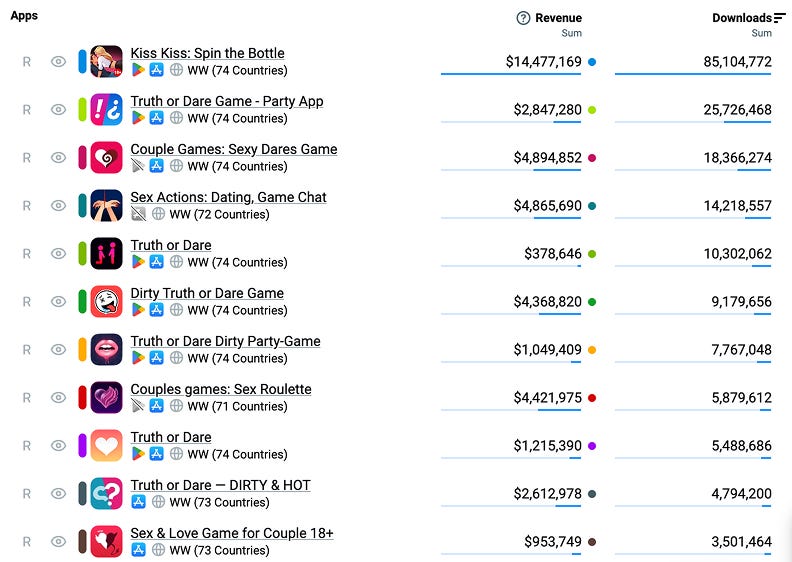
If you look at them closely, they’re basically hypercasual games. The experience is shallow, but the promise is very clear. You’re on a date or out with friends, you open the app, and it delivers immediately.
It’s essentially a board game compressed into a mobile app. Easy to build, easy to understand, easy to monetize.
Music learning apps are another category I keep thinking about. They’ve been around for a long time. Some are profitable and well designed. They already use gamification. But none of them have really produced a breakout on the scale of Duolingo.
Maybe music learning is just a smaller market. Or maybe the engagement never quite crossed some threshold. I’m not sure.
Things from games that feel inevitable
When I step back, it feels like a few things from games are going to move into consumer apps whether people want them or not, not because they’re trendy but because they solve problems that consumer apps keep running into.
The first one is real PVP. Not leaderboards or streak comparisons or being ranked somewhere on a list, but actual head to head interaction inside the content. The moment you put two people into the same piece of content, engagement changes. It stops being analytical and starts becoming emotional. You’re no longer optimizing a number or trying to keep something green. You’re reacting to another person. Duolingo’s streaks already hint at this. Trying to keep a longer streak than someone else is a soft form of PVP, but it never really crosses the line into direct interaction. Once it does, the app stops feeling like a tracker and starts feeling like a game, and that shift is bigger than it looks.
The second thing is live ops. Daily things, weekly things, monthly arcs, something that is happening right now rather than something you can grind whenever you feel like it. Games live on this. It’s how they avoid feeling finished. There’s always a reason to show up today instead of tomorrow. Consumer apps mostly don’t do this, and I think that’s because they’ve been optimized around early subscription conversion rather than long term presence. Live ops only really make sense if you care about people showing up again and again. But when content is cheap, live ops stop being scary. You don’t need a big team or handcrafted everything. You can generate events, challenges, and variations continuously, and once you do that the app stops feeling static.
The third thing is collaborative gameplay, and this one feels especially underexplored. Games figured out a long time ago that doing something together is fundamentally different from doing it alone. Guilds, alliances, teams, shared goals. Most consumer apps are still single player experiences, and even the social ones are usually about comparison rather than cooperation. I’m building around this idea right now, two people progressing together, sharing goals, unlocking things together, and once you start thinking this way it feels obvious that this shouldn’t be limited to couples. Families, households, groups of friends, small communities, even strangers who opt into doing something together. Collaboration changes motivation. You’re no longer only accountable to yourself. You’re accountable to someone else, and that turns out to be a very powerful shift.
Ending thought, not a conclusion
I don’t think the next wave of consumer apps is about more engagement tricks.
I think it’s about generating actual value. Measurable value. Things that matter outside the app, not just inside the metrics dashboard.
If you generate real value, people stay. They talk about it. They pay.
And now that building depth is cheap, it feels like we’re still barely scratching the surface. That’s the part that keeps pulling me back to this.
Great read, thanks for writing and sharing! Agreed on the opportunity fast content creates for meaningful depth
On quick reflection, I see more societal shame around learning / utility apps whereas games and social media are accepted as forms of entertainment and offer the interactions and control that feel tolerable for most. There is a deeper level of vulnerability or authenticity in people sharing experiences on language / music learning or food delivery or music apps, even though I see the potential
This hits. I’ve had the same Duolingo experience 😄 The game loop is elite, but the “cash-out” into real life is weak.
The sneaky mechanism is progress tokens vs transferable skill. Streaks, leagues, XP… they feel like learning, but they don’t force the messy part where ability actually transfers outside the app.
Quick 20-min step I like: define one outcome metric that exists outside the product.
Example for language: “2-min voice convo without freezing” or “understand 60s of a podcast”. Then design 1 weekly challenge that targets that exact cash-out ✅